 How-to
How to Tell If a Tree Is Dangerous: 7 Warning Signs
Table of Contents
- Step 1: Read the Visible Signs a Tree Is Dying
- Step 2: Inspect the Trunk for Cracks, Cavities, and Bark Inclusion
- Step 3: Check the Root Plate and Soil for Instability
- Step 4: Evaluate Lean, Deadwood, and Hanging Limbs
- Step 5: Run a Basic Tree Hazard Assessment Yourself
- Step 6: Know When to Remove a Tree
- Step 7: Build a Seasonal Inspection Checklist
- Common Mistakes Homeowners Make When Judging Tree Safety
- Frequently Asked Questions
Last Updated: September 27, 2026
Step 1: Read the Visible Signs a Tree Is Dying
Learning how to tell if a tree is dangerous starts with the canopy. Our assessments begin with one question: has this tree looked worse each season?
Canopy Thinning and Leaf Chlorosis
A healthy tree pushes out full, even foliage each spring. A bare side means something is wrong.
Watch for these signals:
- Sparse leaves across the whole canopy
- Dead branches on the outer edges
- Yellow or pale leaves in the growing season
- Early leaf drop in late summer
Fungal Fruiting Bodies and Soft Wood
Fungal fruiting bodies are mushrooms or shelf-like growths on bark or roots. They are the clearest sign of internal decay.
Step 2: Inspect the Trunk for Cracks, Cavities, and Bark Inclusion
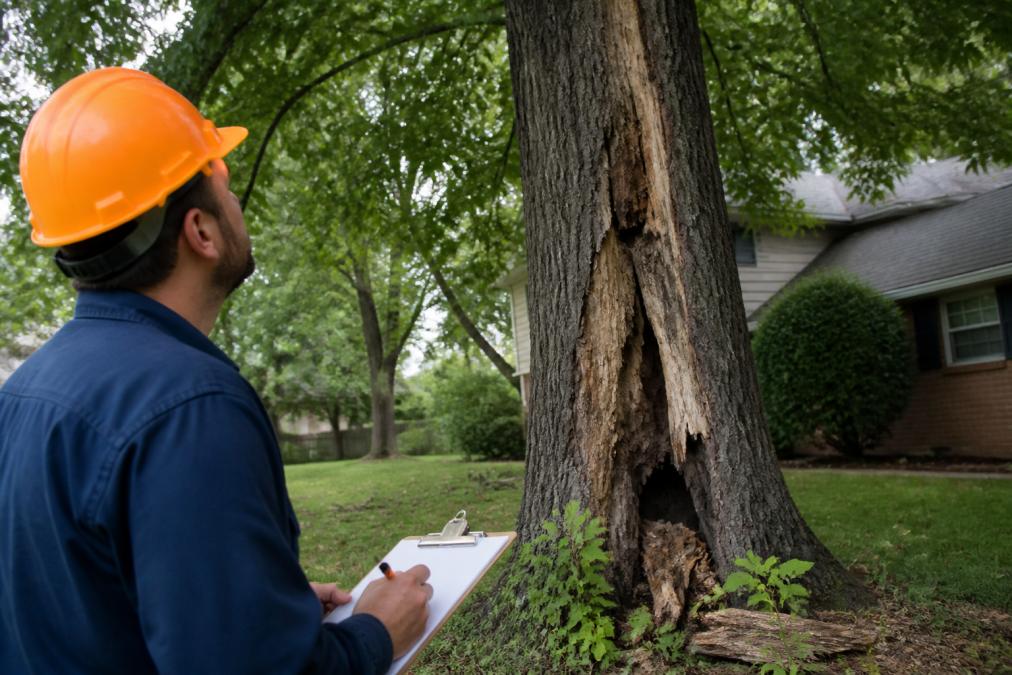
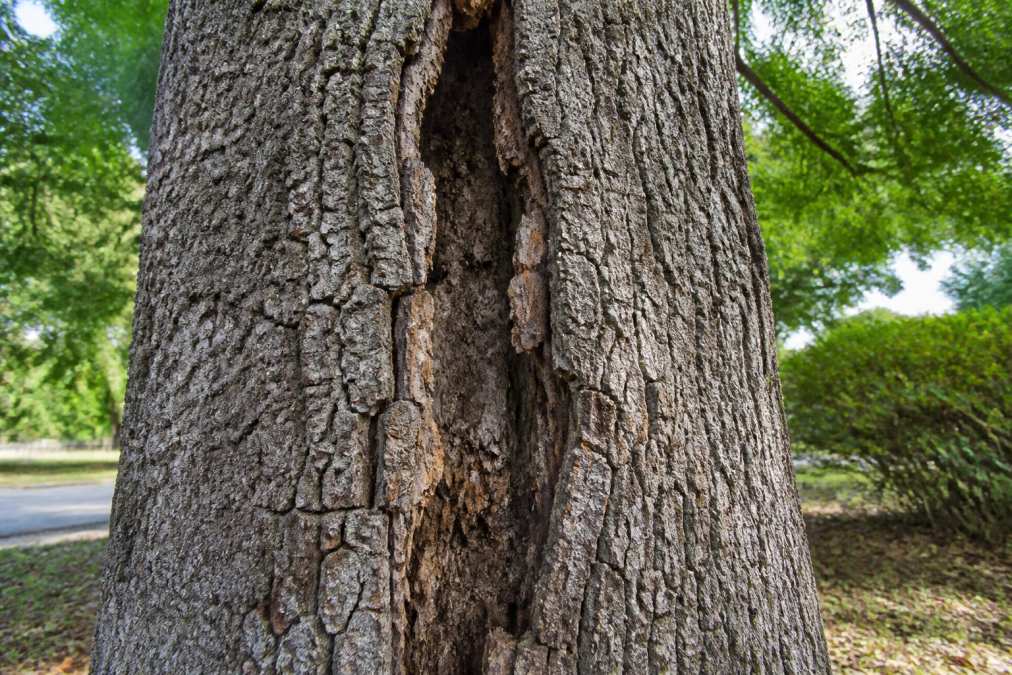
The trunk carries the tree's whole load, so any crack, cavity, or split weakens that load path. Scan from the ground to the first major branches for breaks in the bark.
Vertical Cracks and Codominant Stems
A vertical crack is a split running up the trunk. Shallow or deep, it signals stress.
Look for these:
- Two trunks of similar size meeting in a V
- A visible seam or crease where they join
- Cracks running down from the joint
Decay Pockets and Hollow Sounds
Tap the trunk with a rubber mallet: a solid tree thuds dully, a hollow one rings.
Step 3: Check the Root Plate and Soil for Instability
The root plate is the shallow mat of roots anchoring the tree. When it fails, the whole tree tips. Check the ground within a few feet of the trunk.
Other root warning signs:
- Mushrooms or fungus around the base
- Soft or spongy ground near the trunk
- Exposed roots that look crushed or cut
- New cracks in nearby pavement or soil
Step 4: Evaluate Lean, Deadwood, and Hanging Limbs
Hanging limbs are the most urgent hazard. A limb caught in the canopy can drop at any moment. Keep people and cars away until a professional removes it.
Step 5: Run a Basic Tree Hazard Assessment Yourself
A tree hazard assessment is a structured look at three things: the tree's defects, the site conditions, and the target, whatever a falling tree or limb would strike. You can run a basic version in about 15 minutes with no special tools.
Work through these steps in order:
- Walk the full circle around the trunk, not just the side you see from the driveway
- Check the canopy for deadwood, thinning, and dead tips on the outer branches
- Look for fungus, cracks, seams, and cavities on the trunk and root flare
- Probe the base with a screwdriver for soft wood and check the soil for heaving
- Note the lean and compare it to photos from prior seasons
- Identify the target, what the tree would hit if it failed
How Likelihood and Target Combine
A hazard rating combines two judgments: how likely the tree is to fail, and what that failure would damage. Neither alone tells you whether to act.
Think of it as a simple grid:
- Low likelihood + no target: a declining tree in an open back field. Monitor it. No urgency.
- Low likelihood + high target: a sound tree with one dead limb over a driveway. Prune the limb; the trunk is fine.
- High likelihood + no target: a hollow tree in an empty lot. Schedule removal on your timeline, not the storm's.
- High likelihood + high target: a leaning tree with soil heaving over a bedroom. This is the urgent case, restrict access and call a professional now.
Occupancy and Exposure: What Counts as a Target
A target is anything a failure would hit, and how often people or property are there matters:
- A structure, house, garage, shed, fence line
- A parked vehicle or driveway a car crosses daily
- A utility line or service drop
- A walkway, patio, or play area people use regularly
- A neighboring property the tree overhangs
The DIY vs. Professional Threshold
Some problems you can monitor yourself; others need a certified arborist now. The line is not how bad the tree looks but whether you can safely observe the defect from the ground.
Call a professional if you find any of these:
- A trunk cavity or a hollow sound when you tap the trunk
- Soil heaving, a lifted root plate, or a new lean
- Mushrooms or shelf fungus at the base or on exposed roots
- A large hanging limb caught in the canopy
- A crack running vertically through the trunk
- A codominant stem with a deep bark inclusion
- A tree leaning over a structure, driveway, or utility line
Step 6: Know When to Remove a Tree
Tree removal is the right call when a tree cannot be made safe, not a decision to rush, but not one to delay either.
Removal makes sense when:
- More than half the trunk is decayed
- The root plate is failing
- The tree leans over a structure
- Cabling and bracing cannot fix the weak point
Step 7: Build a Seasonal Inspection Checklist
Tree risk changes with the seasons, and so does what you can see. A tree assessment done once a year misses the shifts that matter: in winter, a bare canopy exposes structural defects; in summer, foliage hides cracks but reveals stress through color and density. You need both views.
Use this calendar as your baseline:
- Late winter (before bud break): the best time to read structure. With no leaves, cracks, codominant stems, bark inclusions, and deadwood are fully visible. Look for dead tips on outer branches and any seam running down a trunk.
- Spring: check for new growth and an even, full canopy. A branch that leafs out late or not at all is dead or dying. Compare the canopy's density side to side.
- Summer: watch for chlorosis (yellowing between green veins), early leaf drop, and pest damage. These point to root or soil stress even when the trunk looks fine.
- Fall: look for early leaf drop, new fungal fruiting bodies, and conks emerging at the base or on roots. Fall is when many wood-decay fungi push out their fruiting bodies.
- After every storm: recheck lean, cracks, hanging limbs, and the root flare for fresh soil movement.
Why Each Season Reveals Different Defects
The seasonal logic is mechanical: decay fungi fruit when moisture and temperature align, often in late summer and fall; cracks open widest with freeze-thaw cycles, so winter reveals them; root plate movement shows as soil heaving after saturated ground, a spring and post-storm pattern. Inspecting on the same schedule trains your eye to catch change, not just the current state.
Post-Storm Inspection Protocol
Extreme weather is the biggest single trigger for tree failure, high winds, ice loading, and heavy rain push weak trees past their limit. Inspect within days of any major storm, in this order:
- From a safe distance first. Do not walk under the tree. Scan the whole canopy for hanging limbs, broken tops, and limbs resting on other limbs.
- Check the lean. Compare the trunk to its pre-storm angle using your seasonal photos. A new lean after a storm means the root plate moved.
- Check the root flare. Look for fresh soil cracks, lifted turf, or a gap opening on one side of the trunk.
- Check the trunk. Look for new vertical cracks, splits at codominant joints, and fresh bark wounds.
- Check for hangers. A limb caught in the canopy can drop without warning. Keep people and vehicles clear until a professional removes it.
Species-Specific Risk Factors
Not all trees fail the same way. Your tree's species sets the failure mode to watch for.
- Brittle-wood species tend to shed limbs rather than bend. They fail suddenly at the branch union, often with little visible warning. Watch the unions and any limb over a target.
- Flexible-wood species bend and recover in wind but can uproot when the soil is saturated, because the wood holds while the root plate gives. Watch the root flare and soil after heavy rain.
- Fast-growing species add wood quickly and often carry a higher ratio of weak, included bark unions. They reach a hazardous size sooner than slow-growing hardwoods.
- Shallow-rooted species are more prone to whole-tree tipping, especially in saturated or compacted soil. Watch for heaving and surface roots.
- Species prone to included bark form weak V-shaped unions where two stems meet. These joints split under snow or wind load.
Setting Your Inspection Pace
Match inspection frequency to the tree, not the calendar. A mature, fast-growing tree with a history of limb drop near a structure deserves a look every season; a young, sound tree in the open may only need an annual check. Any tree showing a defect, a crack, a conk, a new lean, moves to the front of the line until a professional clears it.
Common Mistakes Homeowners Make When Judging Tree Safety
The biggest mistake is judging a tree by how it looks from the ground. A tree can look full and green while the trunk rots inside.
Other common errors:
- Ignoring mushrooms at the base
- Assuming a lean is "just how it grew"
- Waiting until a limb falls before acting
- Trying to remove a large tree without training
- Skipping inspections after storms
Frequently Asked Questions
How do I know if a tree is at risk of falling?
Look for a combination of warning signs rather than a single one. A tree with a sudden lean, soil heaving at the base, vertical trunk cracks, or fungal fruiting bodies on the bark is at higher risk. A leaning tree that has leaned for years is usually stable, but a lean that appeared recently, especially after a storm, points to root plate failure. When two or more signs appear together, treat the tree as an immediate hazard and get a professional assessment.
Can a tree look healthy but still be dangerous?
Yes. A tree can hold a full canopy while its structural integrity is already compromised. Decay inside a trunk cavity or a hollow core may not show on the outside until the tree fails. Codominant stems with bark inclusion, hidden root rot, and internal decay pockets are common in trees that look fine from the ground. This is why a tree hazard assessment from a certified arborist matters for large trees near homes, driveways, or power lines.
What are the signs of root rot in large trees?
Watch for soil heaving or cracking around the root plate, mushrooms growing at the base of the trunk, soft or spongy wood near the soil line, and a canopy that thins from the top down. Root rot weakens the tree's anchor, so the tree may lean or wobble in wind. Because the damage is underground, a visual check from the surface only tells part of the story. An arborist can use resistograph or excavation tools to confirm decay before deciding on tree removal.
When should I call a professional instead of assessing the tree myself?
Call a certified arborist when the tree is larger than 20 inches in trunk diameter, when it sits within falling distance of a structure, when you see a cavity, crack, or fungal growth on the trunk, or when the tree has leaned after a storm. Homeowners can safely check foliage density and look for deadwood, but structural defects need an in-person inspection. If any part of the tree overhangs a roof, driveway, or power line, do not try to remove it yourself.